

By Ivan Kesic
AhlulBayt News Agency: In a striking admission signaling a dramatic shift in global military assessments, a recent Wall Street Journal report confirmed that militaries worldwide, including in Western countries, are now actively seeking to replicate Iran’s cutting-edge Shahed drone.
The report stated that corporations in the US, China, France, and the UK are locked in a full-scale race to develop armed unmanned aerial vehicles modeled directly on the Iranian original.
Western military-industrial complexes that once dominated the global arms market are now turning to low-cost, long-range replica weapons, with models strikingly similar to the Shahed standing out among prototypes displayed at a US Department of Defense (aka Department of War) event this past summer.
Arms manufacturers like SpectreWorks, with its LUCAS drone, and Griffon Aerospace, with its Arrowhead, underscore a fundamental truth: an Iranian-designed weapon has effectively redefined the parameters of modern warfare.
The Shahed and its growing number of knockoffs have become so widespread that corporations are even selling target-practice UAVs resembling Iran’s munitions, a tacit acknowledgment of the Iranian drone pre-eminence and the need to adapt to a new reality shaped by Tehran’s aerospace ingenuity.
This newfound respect from American military planners marks a stark departure from years of Western denial, dismissal, and derision toward Iranian military technology.
For over a decade, Western media and military pundits consistently dismissed and questioned the prowess of Iranian weapons, often ridiculing new systems as propaganda or crude imitations.
Back in November 2012, The Atlantic openly mocked Iranian media reports about a vertical take-off and landing drone, while outlets like The Register accused Tehran of using photoshopped images from a Japanese university to mislead the world.
This narrative, which extended to other platforms like the Karrar and Qaher-313 drones, underestimated Iran’s capacity for indigenous innovation, a miscalculation that proved strategically costly.
The Shahed’s journey from object of ridicule in Western capitals to blueprint for future American weapons is a testament to quiet, relentless technological advancement, achieved despite illegal and crippling international sanctions.
What did Trump say about Shahed-136 in May?
The most significant validation of this shift came not only from technical reports but from the highest political office in the United States.
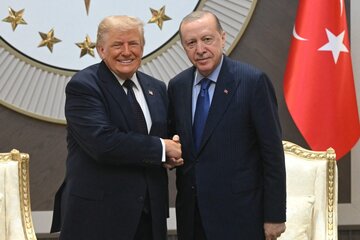
During a visit to Qatar in May 2025, President Donald Trump made a series of admissions, openly praising Iranian drones for their efficiency, affordability, and devastating effectiveness.
In a speech centered on US-Arab relations and American military strength, Trump described the Iranian drones as “very good, fast, and deadly,” emphasizing their pivotal role in the war in Ukraine.
He revealed that he had directly challenged American arms manufacturers to produce a comparable drone, only to be quoted an astonishing $41 million for a model similar to Iran’s, which costs merely $35,000 to $40,000.
The vast cost differential prompted Trump to critique the US military-industrial complex for overpricing sharply, and he explicitly urged that America learn from Iran’s cost-efficient production methods.
His remarks, punctuated with a vivid depiction of the drone’s lethality – “You hide behind a tree, a drone comes down and circles you with fire. You don’t have a chance” – signaled a profound acknowledgment that the paradigm of warfare has shifted, and Iran currently holds a significant lead in this domain.
How did Shahed-136 redefine asymmetric warfare?
The focus of worldwide attention and admiration is the Shahed‑136, an Iranian‑manufactured, low‑cost, long‑range loitering munition that has changed the tactical calculus.
Built as part of Iran’s strategy to field inexpensive, asymmetric weapons, the Shahed‑136 is a kamikaze drone engineered for precision strikes on high‑value targets.
Its straightforward but effective design employs a delta‑wing airframe with a pusher propeller driven by a reverse‑engineered German engine, giving the system a wingspan of roughly 2.5 metres and a mass in the order of 200–250 kilograms.
The Shahed‑136’s formidable capabilities stem from its key performance characteristics: it can travel at speeds of 185-200 km/h and has an estimated operational range of up to 2,500 km, enabling it to strike targets deep behind enemy lines.
Its payload — a 40-50 kg high-explosive warhead — is sufficient to destroy or severely damage infrastructure, command centers, and fuel depots.
The drone’s true ingenuity lies not in any single advanced technology but in its design philosophy emphasizing affordability and mass production.
It is specifically engineered for saturation attacks, where dozens or even hundreds of drones are launched simultaneously to overwhelm sophisticated and costly air-defense systems.
A single Patriot interceptor missile, which can cost millions of dollars, may be deployed against a drone produced for mere tens of thousands, creating a stark economic imbalance for defenders.
Launched from simple mobile racks that hold five drones each, the Shahed‑136 requires minimal infrastructure and can be deployed in large numbers from dispersed locations.
Its small radar cross-section and low-altitude flight path make it difficult to detect and track, and when employed in swarms, it poses a nearly unmanageable threat.
What are the copies and derivatives of this game-changer?
The demonstrated effectiveness of the Shahed‑136 on the modern battlefield has sparked a wave of international replication, with at least six countries developing their own copies or derivatives by now, each adapting the core Iranian design to their specific strategic needs and industrial capabilities.
The most prolific and well-documented adopter is Russia, which operates the drone under the name Geran‑2.
Through a combination of licensed production and technology transfer from Iran, Russia has scaled up manufacturing at facilities such as the Alabuga factory in Tatarstan, with ambitions to produce over 50,000 units annually by 2026.
The Russian variant is virtually identical to the original Shahed‑136, with minor modifications for GLONASS integration, and has been launched in waves of hundreds of drones in a single night, forming the backbone of Russia’s long-range strike capability in Ukraine.
Building on this foundation, Russia has already developed an upgraded version, the Geran‑3, based on the Iranian Shahed‑238. This model replaces the piston engine with a turbojet for higher speeds, blurring the line between low-cost drones and cruise missiles.
Prompted by the challenges in Ukraine and the Red Sea, the US military has responded with its own reverse-engineering efforts.
American companies like Griffon Aerospace have developed the MQM‑172 Arrowhead, a near one-to-one replica initially intended as a target drone to train air defenses against the Shahed threat.
Similarly, Spektre Works has unveiled the LUCAS (Low-Cost Uncrewed Combat Attack System), a delta-wing drone with a similar profile and a cost target of around $35,000, explicitly designed to emulate the Iranian model for training and potential offensive use.
China has incorporated design elements into its CH-series loitering munitions for export and anti-ship roles. The almost identical Sunflower‑200 uses vertical takeoff with a propeller and no booster.
Beyond the great powers, the design has proliferated widely. Poland has fielded the PLargonia, a scaled-down version with a 600‑kilometer range, which Ukraine has used to strike Russian energy infrastructure.
Ukraine has also developed its own Batyar copy, while Saudi Arabia fields the UnmannedX X‑1500. Similar developments are believed to be underway in India, Turkey, North Korea, and France.
This global spread underscores the Shahed‑136’s status as a democratizing force in military technology, enabling a broader range of actors to possess a credible long-range strike capability that challenges the dominance of traditional air powers.
Born from a strategy of self-reliance, the Iranian drone has not only proven its mettle in combat but has also become a standard against which future unmanned systems are now measured.
/129



Your Comment